We are not stopping here, however. The investment in the installer has given us the know-how necessary to improve and simplify the installation of our flagship product (Tungsten Enterprise) which is about to ship with similar usability enhancements. We have plans to enhance multiple master replication and management, we are developing powerful parallel processing administration tools, and we are also trying to simplify the powerful filters that Tungsten provides. There are more open source releases to discuss, but these will require more than one article to be described conveniently. We have released more tools in the Tungsten Toolbox project. A better Tungsten Sandbox, capable of installing every technology, and some more ancillary tools for Tungsten. I will come back to those in the near future. Much as I like coding, I also like talking about the cool things that we have made. And, another thing that kept me busy and happy: Continuent and SkySQl are now partners. This has given me quite a lot of work, since we had deliver training to SkySQL field operatives. It was a beautiful experience (teaching to a class of advanced users always is) also because most of the attendees were my former colleagues at MySQL AB. The future looks good. More to come.
Tuesday, March 06, 2012
Tungsten 2.0.5 with more power and ease of use
Tungsten Replicator 2.0.5 was released this week-end. The release notes have quite a long list of bug fixes. Thanks to all the ones who have submitted bug reports, and fixes! There are a couple of new features as well. The replicator includes now a slave prefetch service. Unlike parallel replication, this feature works fine with a single database, and provides performance improvements that in many cases solve the slave lagging problems. This was a bitch of a feature to get right. Many have tried it, many have experienced various degrees of success, and several failures. We started with the bold assertiveness of the brave after an exciting talk at Percona Live in October, and I was sorry to report one bad performance result after the other for a few months, until finally the tide turned, and the good results started showing up, and improving! The key to success was the realization that the prefetch is hard to set up and tune right, but also the need for multiple threads that do the pre-fetching efficiently. Since we had already an efficient engine that we use for parallel replication, the final design started bearing fruits at the end of January, and became definitely good and reliable in February. The other noteworthy improvements were made in the installer. Thanks to the many users who have tried it and reported usability issues, we have made the Tungsten Replicator installation a much better experience, and a powerful tool. The best proof of the installer maturity is that the prefetch installation required little work to be implemented and it worked flawlessly at the first attempt! Other improvements in the tools include trepctl and thl better understanding of their environment. They no longer require a service name if there is only one installed in a given host, and they provide more instrumentation for parallel replication, pre-fetching, and for the processing of huge transactions (quite common when dealing with RBR). This version was also the first with Oracle to MySQL support. This is not open source, however. As this feature requires substantial investments, it is not possible to release it as the rest of the replicator. But the list of goodies is not over yet. The feature that probably more than anything else has been used in the past months has been the star schema topology, which is something that was probably possible in 2.0.4, but nobody had tried it before.
We are not stopping here, however. The investment in the installer has given us the know-how necessary to improve and simplify the installation of our flagship product (Tungsten Enterprise) which is about to ship with similar usability enhancements. We have plans to enhance multiple master replication and management, we are developing powerful parallel processing administration tools, and we are also trying to simplify the powerful filters that Tungsten provides. There are more open source releases to discuss, but these will require more than one article to be described conveniently. We have released more tools in the Tungsten Toolbox project. A better Tungsten Sandbox, capable of installing every technology, and some more ancillary tools for Tungsten. I will come back to those in the near future. Much as I like coding, I also like talking about the cool things that we have made. And, another thing that kept me busy and happy: Continuent and SkySQl are now partners. This has given me quite a lot of work, since we had deliver training to SkySQL field operatives. It was a beautiful experience (teaching to a class of advanced users always is) also because most of the attendees were my former colleagues at MySQL AB. The future looks good. More to come.
Friday, January 27, 2012
More Oracle ACEs for MySQL
As Keith announced today, there are two more Oracle ACE Directors for MySQL expertise. In case you are wondering how an ACE Director compares to a regular ACE, here is an overview and some FAQ.
Wednesday, January 18, 2012
MySQL and Friends schedule at FOSDEM 2012
The MySQL DevRoom at FOSDEM is ready. The schedule has been voted. Thanks to all who have participated. Now, let's make sure that the event is successful. The schedule is juicy, and not only because I have three talks in it! UPDATE The schedule has changed. Speakers with more than one talk have been asked to give up one. Now I have two talks instead of three.
Labels:
community,
conference,
events,
fosdem,
mysql,
replication,
tungsten
Monday, January 02, 2012
Time to vote for MySQL sessions at FOSDEM
There is a room dedicated to MySQL at FOSDEM 2012. (Thanks to @lefred for organizing).
The CfP has received 37 submissions, but there will be time slots only for 12 to 15 talks. So now it's up to the community. If you want to attend a particular talk, you should vote for it.
Like in previous years, the selection of the talks is public. You can see the list of the proposals, with the instructions, which I repeat here.
You can vote either publicly, using Twitter, or privately, by sending an email. Each talk proposal will be referred by the number immediately after the title in this page. This number indicates the order in which the proposals were received.
In public, you should send a tweet to @opensqlcamp, indicating a maximum of 12 talks that you would like to see, in the order you like them. e.g. "@opensqlcamp #FOSDEM2012 1,2,3,4,5,6,7,8,9,10,11,12 http://bit.ly/mysql_fosdem_2012" (adding the link will help others to find the page.
In private, by email at mysqlfriends AT gmail DOT com, using the same method used for Twitter. Maximum 12 talks, in the order of your preference.
In both cases, votes for your preferences will result in 1 point for each talk. In case of equal voting, we will assign 12 points to the first in the list, 11 to the second, and so on. We'll do the tally, and choose the most popular ones.
Anonymous votes either by Twitter or email won't be counted. If you want your vote to count, make sure your twitter account has a recognized name (or known nick) on it. If your email address doesn't spell your name, please sign the message with your real one.
DEADLINE: Your votes must be entered by January 8th, 2011.
|
Labels:
community,
conference,
database,
fosdem,
free software,
mysql,
opensqlcamp,
participation,
presentations,
tungsten
Monday, December 19, 2011
Testing new builds with MySQL-Sandbox 3.0.24
MySQL::Sandbox 3.0.24 was released yesterday, with many new features.
More than vanilla MySQL
If you have missed my previous announcement, here's the gist of it. MySQL Sandbox can now deal with tarballs from either Percona Server or MariaDB. The main difference after this change is that you can now create a directory called <PREFIX>5.5.16 and make_sandbox will recognize it as well as the plain 5.5.16.$ make_sandbox --export_binaries --add_prefix=ps \ Percona-Server-5.5.11-rel20.2-114.Darwin.i386.tar.gz \ -- --sandbox_directory=msb_ps5_5_11 unpacking Percona-Server-5.5.11-rel20.2-114.Darwin.i386.tar.gz […] installing with the following parameters: upper_directory = /Users/gmax/sandboxes sandbox_directory = msb_ps5_5_11 […] basedir = $HOME/opt/mysql/ps5.5.11 tmpdir = […] Your sandbox server was installed in $HOME/sandboxes/msb_ps5_5_11After the binary export, subsequent installations will be easier:
$ make_sandbox ps5.5.11The same commands can be used for MariaDB. At the moment, make_sandbox does not recognize other packages, but adding them should not be a big deal, provided that such packages look like MySQL. It wouldn't work with Drizzle, because it lacks the main ingredients for MySQL installation.
High Performance sandboxes
While testing parallel replication and prefetch slaves with Tungsten Replicator, I realized that I was doing too much manual fiddling with my scripts. Since I need more performant servers, I added the basic items that I need to modify to enable a faster server. Now, using the '--high_performance' option with make_sandbox, you get a server that is much better than out-of-the-box MySQL. To avoid problems with too much RAM, I am using a default of 512 MB for InnoDB, which is not enough for really demanding tests, but at least it is a good placeholder in the sandbox configuration file, should you need to modify it.$ make_sandbox 5.1.60 -- --high_performance […] innodb-flush-method=O_DIRECT ; \ innodb-log-file-size=50M ; \ innodb_buffer_pool_size=512M ; \ max_allowed_packet=48M ; \ max-connections=350 ; \ innodb-additional-mem-pool-size=50M ; \ innodb-log-buffer-size=50M ; sync_binlog=0 ; \ innodb-thread-concurrency=0 ; log-error=msandbox.err […]
Standalone masters and slaves
MySQL Sandbox has had the ability of creating replicated systems for years. Yet, sometimes you need a stand-alone master server that you want to use for some odd experiment. Similarly, you may want to create a slave of a specific master without having a full replication system. One case where you would like this ability is when you want to try replicating between servers of different versions.$ make_sandbox 5.1.57 -- --master
[…]
my_clause = server-id=5157 ; log-bin=mysql-bin ; log-error=msandbox.err
[…]
Your sandbox server was installed in $HOME/sandboxes/msb_5_1_57
$ make_sandbox 5.5.10 -- --slaveof='master_port=5157'
[…]
my_clause = server-id=5510 ; log-bin=mysql-bin ; log-error=msandbox.err
[…]
Your sandbox server was installed in $HOME/sandboxes/msb_5_5_10
$ ~/sandboxes/msb_5_1_57/use -e 'show master status'
+------------------+----------+--------------+------------------+
| File | Position | Binlog_Do_DB | Binlog_Ignore_DB |
+------------------+----------+--------------+------------------+
| mysql-bin.000001 | 106 | | |
+------------------+----------+--------------+------------------+
$ ~/sandboxes/msb_5_5_10/use -e 'show slave status\G'
*************************** 1. row ***************************
Slave_IO_State: Waiting for master to send event
Master_Host: 127.0.0.1
Master_User: rsandbox
Master_Port: 5157
Connect_Retry: 60
Master_Log_File: mysql-bin.000001
Read_Master_Log_Pos: 106
Relay_Log_File: mysql_sandbox5510-relay-bin.000002
Relay_Log_Pos: 252
Relay_Master_Log_File: mysql-bin.000001
Slave_IO_Running: Yes
Slave_SQL_Running: Yes
Replicate_Do_DB:
Replicate_Ignore_DB:
Replicate_Do_Table:
Replicate_Ignore_Table:
Replicate_Wild_Do_Table:
Replicate_Wild_Ignore_Table:
Last_Errno: 0
Last_Error:
Skip_Counter: 0
Exec_Master_Log_Pos: 106
Relay_Log_Space: 420
Until_Condition: None
Until_Log_File:
Until_Log_Pos: 0
Master_SSL_Allowed: No
Master_SSL_CA_File:
Master_SSL_CA_Path:
Master_SSL_Cert:
Master_SSL_Cipher:
Master_SSL_Key:
Seconds_Behind_Master: 0
Master_SSL_Verify_Server_Cert: No
Last_IO_Errno: 0
Last_IO_Error:
Last_SQL_Errno: 0
Last_SQL_Error:
Replicate_Ignore_Server_Ids:
Master_Server_Id: 5157
You can download MySQL::Sandbox from either launchpad or CPAN.
Saturday, December 10, 2011
How to submit a good database bug report
When an open source project becomes popular, bug reports start flocking in. This is both good and bad news for the project developers. The good news is that someone is using the product, and they are finding ways of breaking it that we didn't think of. The bad news is that most of the times the reporters assume that the developers have super human powers, and that they will find what's wrong by the simple mentioning that a given feature is not working as expected. Unfortunately, it doesn't work that way. An effective bug report should have enough information that the ones in charge will be able to reproduce it and examine in lab conditions to find the problem. When dealing with databases and database tools, there are several cases, from simple to complex. Let's cover them in order.
Installation issues
This is often a straightforward case of lack of functionality. When a tool does not install what it is supposed to, it is a show stopper, and a solution must be found. In this case, it's often enough to state the environment where the installation is happening (operating system, version of the tool, version of core components such as the MySQL database used) and the command used to start the installation. The error message could be an expected failure, when the installation procedure checks for requirements and fails if they are not met. For example: "Missing Ruby interpreter". The message tells (or suggests) you what to do. Filing a bug report on an expected failure is a waste of time. You should install the missing part and try again. Even if the message is about an unexpected failure (e.g. you get a stack trace from Ruby or Java), usually the first message tells you enough to be able to find a workaround. For example, if you get an exception from Ruby complaining about a missing 'curl' command, you can file a bug report to ask for the installer to check for 'curl' in the requirements, but if you install 'curl' yourself, the installation should continue.Simple database issues
Reporting a database bug means complaining that the DBMS is not behaving as advertising by the documentation, or as common usage dictates. If it is a missing or misbehaving functionality, the best way of showing the problem is by starting with an empty DBMS, followed by the creation of the objects needed to reproduce the issue (CREATE SCHEMA, TABLE, INDEX) and by a minimal amount of data that triggers the problem. Some information about what operating system and database version was used is probably necessary to reproduce the problem consistently.Simple database replication issues
By simple replication we mean a vanilla master/slave topology. In this scheme, data inserted in the master will eventually end up in the slave. Bugs in this category may fail to replicate the data totally or partially, or they may cause a break in the replication flow. Reproducing them is almost as easy as with simple database bugs. If you start with an empty system and manage to reproduce the error with a short sequence of commands, it should probably reproducible by a third party. Sometimes, settings in the master and the slave are essential to reproduce the problem. In MySQL, the format of binary logs, the default database engine and SQL modes can affect replication and produce different results with the same stream of SQL commands.Complex database replication issues
The most difficult bugs to report are the ones where the error shows up only in a given topology. While MySQL native replication offers only few options to pipe data around (single, circular, hierarchical), Tungsten replicator allows a rich set of combined pipelines that can change the outcome of a data change event, depending on the originating node and the direction it took. In these case, information o how the cluster was installed becomes essential.Concurrency issues
This is one of the most difficult bugs to report. When an error happens only because of the contemporary action of two or more threads, there is no easy way of reporting it in a way that it can be easily reproduced. Three methods are possible:- Describe the action of the first thread, then mark the change of thread and describe the actions of the second thread, continuing in this way until you reach the error point.
- If you are a developer and feel comfortable with multi thread applications, write a script that reproduces the error by running several threads (Perl, Python, and Ruby offer the best environment for this kind of tests).
- If the database offers a tool to write such multi-threading tests, consider using it.
Heavy load issues
This is a more complex case of the above one. Not only you need concurrency, but a lot of it happening at the same time. Reproducing this kind or error is challenging. If you have a support agreement with the provider of the database or the tool, you may let the support engineer have a look at your running environment, to find some clues. But even in this case, the support engineers or yourself need to ultimately reproduce the case in such a way that a developer can fix the problem and test the fix. There are two methods to report this problem:- Simplification: if you can reduce the concurrency to the elements that are misbehaving, the methods for concurrency issues will apply also in this case.
- Enabling a query log could lead to identifying the sequence of events that have generated the error. The log should be integrated by the DDL of the objects involved in the action (schemas, tables, triggers, views, etc).
Large data issues
If your error only shows itself with large data, there is often a logistical problem, as you can't easily provide gigabytes of data, even if there privacy and security issues weren't in the way (which usually are). There are three strategies that you can use to report such bugs:- If only the size matters, then describing the kind of data used could be enough. E.g. When a table with such fields and such indexes grows beyond X GB, then the optimizer warp drive explodes. (Don't try this at home)
- Create a script to generate the data that will ultimately trigger the error. This method requires both skills and an understanding of what the error is.
- You may use a publicly available database to reproduce the error (for example, the Sample database with test suite.) Just mention in the bug report where to find the database, eventually how to load it if it is not simple, and then describe the steps needed to reproduce the bug after loading it.
DOs and DONTs
- DO
- Search the bug repository and the mailing lists (or forums) before submitting yours. Someone may have had the same problem before you did. (Thanks, Robert Hodges, for this important reminder.)
- Put yourself in the receiver's position, and try to reproduce the problem from a clean initial state.
- If there is a workaround, mention it: it might give a good clue to the developers.
- More information is better. Anything that can improve the identification of the bug root cause will be welcome. (But don't overdo: see below)
- If you feel that a missing feature should be useful, report it as a feature request. (Even better: suggest a patch)
- DON'T
- Don't report a missing feature as a bug, unless the docs say that the feature should be there.
- Don't just send the error message without the events that generated it.
- Don't include SQL commands embedded in code.
- Don't say "my application doesn't work anymore," assuming it's the database's fault. Remember The First Rule of Programming: It's Always Your Fault
- Less is better. If there is a long way and a short way of reproducing the bug, the shorter one is better. Don't send more info just for the sake of it.
- Don't tell the developers that they are retarded. This will not increase the priority given to your bug, or your credibility.
Labels:
bugs,
mysql,
replication,
tungsten
Friday, December 02, 2011
Call for participation for MySQL events - MySQL conference and FOSDEM
It's that time of the year where MySQL would be speakers are called to action. As usual, the main event is the MySQL spring conference, this year hosted by Percona. The call for participation to the MySQL Conference And Expo 2012 is still open until December 5th. To submit a proposal, you should register as a speaker and then fill in the form.
There is a conference committee which is already busy evaluating the proposals that have been submitted so far. The committee is demanding (I know for a fact, since I am in it!) and therefore, if you want to submit something, be very critical with yourself and polish your proposal as if your job depended on it!
Please read an update on Percona Live MySQL Conference & Expo 2012.
Speakers in Europe have some more duty, though. This is also the time to submit talks for FOSDEM MySQL DevRoom. Thanks to Frédéric Descamps and Sergey Petrunia, we have Room H.1309 with 150 seats on Sunday 5th February 2012, all day. The deadline to submit a talk proposal is December 26th. There is no review committee. Like we did on past editions, as soon as the talks are submitted, we will ask everyone to vote on the talks via Twitter or email. More updates will come soon. Of course, participation to FOSDEM DevRoom is not limited to European speakers. There have been several brave speakers who have willingly crossed the pond to offer their services at European conferences before, and they are welcome to repeat the experience. Submit your talk proposals now.
There is a conference committee which is already busy evaluating the proposals that have been submitted so far. The committee is demanding (I know for a fact, since I am in it!) and therefore, if you want to submit something, be very critical with yourself and polish your proposal as if your job depended on it!
Please read an update on Percona Live MySQL Conference & Expo 2012.
Speakers in Europe have some more duty, though. This is also the time to submit talks for FOSDEM MySQL DevRoom. Thanks to Frédéric Descamps and Sergey Petrunia, we have Room H.1309 with 150 seats on Sunday 5th February 2012, all day. The deadline to submit a talk proposal is December 26th. There is no review committee. Like we did on past editions, as soon as the talks are submitted, we will ask everyone to vote on the talks via Twitter or email. More updates will come soon. Of course, participation to FOSDEM DevRoom is not limited to European speakers. There have been several brave speakers who have willingly crossed the pond to offer their services at European conferences before, and they are welcome to repeat the experience. Submit your talk proposals now.
Labels:
california,
community,
conference,
europe,
fosdem,
mysql,
percona,
santa clara
Thursday, December 01, 2011
Never say "there is no way"
Reading a recent MySQL book, I saw an example of SHOW CREATE TABLE that comes with backticks (`) around the table and column names, and a comment:
Here's how it goes:
Instead of "tr -d '`'", you can use "sed -e 's/`//g'", which does the same thing.
If you are running the query at the command line, you may use the pipe directly:
Unfortunately, there is no way to remove this from generated syntax with this command.(Emphasis mine).
Here's how it goes:
mysql> show create table mytest\G
*************************** 1. row ***************************
Table: mytest
Create Table: CREATE TABLE `mytest` (
`id` int(11) NOT NULL,
`description` varchar(50) DEFAULT NULL,
PRIMARY KEY (`id`)
) ENGINE=InnoDB DEFAULT CHARSET=latin1
1 row in set (0.00 sec)
Of course, there is a way!mysql> pager tr -d '`'
PAGER set to 'tr -d '`''
mysql> show create table mytest\G
*************************** 1. row ***************************
Table: mytest
Create Table: CREATE TABLE mytest (
id int(11) NOT NULL,
description varchar(50) DEFAULT NULL,
PRIMARY KEY (id)
) ENGINE=InnoDB DEFAULT CHARSET=latin1
1 row in set (0.00 sec)
Never say "there is no way!"Instead of "tr -d '`'", you can use "sed -e 's/`//g'", which does the same thing.
If you are running the query at the command line, you may use the pipe directly:
$ mysql -e 'show create table test.mytest\G' | tr -d '`'
*************************** 1. row ***************************
Table: mytest
Create Table: CREATE TABLE mytest (
id int(11) NOT NULL,
description varchar(50) DEFAULT NULL,
PRIMARY KEY (id)
) ENGINE=InnoDB DEFAULT CHARSET=latin1
Friday, November 04, 2011
Replication stars
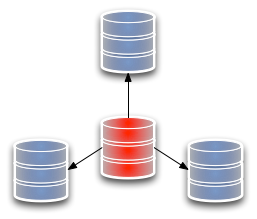
Working with replication, you come across many topologies, some of them sound and established, some of them less so, and some of them still in the realm of the hopeless wishes. I have been working with replication for almost 10 years now, and my wish list grew quite big during this time. In the last 12 months, though, while working at Continuent, some of the topologies that I wanted to work with have moved from the cloud of wishful thinking to the firm land of things that happen. My quest for star replication starts with the most common topology. One master, many slaves.
It looks like a star, with the rays extending from the master to the slaves. This is the basis of most of the replication going on mostly everywhere nowadays, and it has few surprises. Setting aside the problems related to failing over and switching between nodes, which I will examine in another post, let's move to another star.
The multiple source replication, also known as fan-in topology, has several masters that replicate to the same slave. For years, this has been forbidden territory for me. But Tungsten Replicator allows you to create multiple source topologies easily. This is kind of uni-directional, though. I am also interested in topologies where I have more than one master, and I can retrieve data from multiple points.
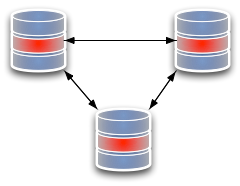
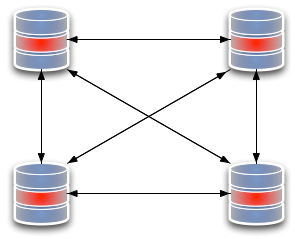
Tungsten Multi-Master Installation solves this problem. It allows me to create topologies where every node replicates to every other node. Looking at the three-node scheme, it appears a straightforward solution. When we add one node, though, we see that the amount of network traffic grows quite a lot. The double sided arrows mean that there is a replication service at each end of the line, and two open data channels. When we move from three nodes to four, we double the replication services and the channels needed to sustain the scheme. For several months, I was content with this. I thought: it is heavy, but it works, and it's way more than what you can do with native replication, especially if you consider that you can have a practical way of preventing conflicts using Shard Filters. But that was not enough. Something kept gnawing at me, and from time to time I experimented with Tungsten Replicator huge flexibility to create new topologies. But the star kept eluding me. Until … Until, guess what? a customer asked for it. The problem suddenly ceased to be a personal whim, and it became a business opportunity. Instead of looking at the issue in the idle way I often think about technology, I went at it with practical determination. What failed when I was experimenting in my free time was that either the pieces did not glue together the way I wanted, or I got an endless loop. Tungsten Replicator has a set of components that are conceptually simple. You deploy a pipeline between two points, open the tap, and data starts flowing in one direction. Even with multiple masters replication, the principle is the same. You deploy many pipes, and each one has one purpose only.
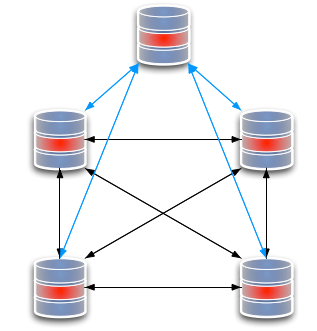
In the star topology, however, you need to open more taps, but not too many, as you need to avoid the data looping around. The recipe, as it turned out, is to create a set of bi-directional replication systems, where you enable the central node slave services to get changes only from a specific master, and the slave services on the peripheral nodes to accept changes from any master. It was as simple as that. There are, of course, benefits and drawbacks with a star topology, compared to a all-replicate-to-all design. In the star topology, we create a single point of failure. If the central node fails, replication stops, and the central node needs to be replaced. Instead, the all-to-all design has no weaknesses. Its abundance of connections makes sure that, if a node fails, the system continues working without any intervention. There is no need for fail-over.
However, there is a huge benefit in the node management. If you need to add a new node, it costs two services and two connections, while the same operation in the all-to-all replication costs 8 services and 8 connections. With the implementation of this topology, a new challenge has arisen. While conflict prevention by sharding is still possible, this is not the kind of scenario where you want to apply it. We have another conflict prevention mechanism in mind, and this new topology is a good occasion make it happen. YMMV. I like the additional choice. There are cases where a all-replicate-to-all topology is still the best option, and there are cases where a star topology is more advisable.
| Fig 1. Master/Slave topology | Legend |
| Fig 2. Fan-in slave, or multiple sources |
| Fig 3. all-to-all three nodes | Fig 4. All-to-all four nodes |
| Fig 5. All-masters star topology |
| Fig 6. extending an all-to-all topology | Fig 7. Extending a star topology |
Tuesday, October 18, 2011
Tungsten Replicator and MySQL Sandbox at Percona Live London 2011
|
I will be a speaker at Percona Live - London 2011, and I am looking forward to the event, which is packed with great content. A whopping 40 session of MySQL content, plus 3 keynotes and 14 tutorials. It's enough to keep every MySQL enthusiast busy.
Continuent speakers will be particularly busy, as between me and Robert Hodges, we will be on stage four times on Tuesday, October 25th.
|
Our talks
Robert will open the dances with Teaching an Old Dog New Tricks: Tungsten Enterprise Clusters for MySQL, a talk about Tungsten Enterprise, my company's commercial product, which is a professional managing tool for demanding companies. Robert, again in the afternoon, with one of the most amazing features of our open source product, Tungsten Replicator: MySQL Parallel Replication in 5 Minutes or Less. This is a feature for large replication systems where the slave can't cope with large data streams, due to the singled-thread MySQL slave. This talk will show how easy is it to plug Tungsten Replicator to a lagging slave, start parallel replication until the lag has been zeroed, and then hand over the control to the native replication again. Then it will be my turn, with a general presentation about Tungsten Replicator, the open source product. I like the idea of calling it MySQL Replication outside the box : multiple masters, fan-in, parallel apply. The reasoning is that MySQL replication, although wildly successful in the web economy of the last decade, it is also constrained by several limits, which Tungsten, acting outside the boundaries, sets free. This will be a quick intro to Tungsten and its new user-friendly installation, with a few demos. Finally, a classic presentation with some new content, on MySQL Sandbox: a framework for productive laziness. The news is that MySQL Sandbox now supports Percona and MariaDB builds. Again, some demos will be shown, with old and new features mixed together.
Labels:
community,
conference,
free software,
london,
mysql,
open source,
percona,
presentation,
replication,
sandbox,
tungsten
Thursday, September 22, 2011
Upgrading Tungsten Replicator: as easy as ...
When I talked about the usability improvements of Tungsten Replicator, I did not mention the procedure for upgrading.
I was reminded about it by a question in the TR mailing list, and since the question was very relevant, I updated the Tungsten Cookbook with some quick upgrading instructions.
A quick upgrading procedure is as important as the installer. Since we release software quite often, either because we have scheduled features to release or because of bug fixes, users want to apply a new release to an existing installation without much fuss. You can do the upgrade with a very quick and painless procedure.
Let's suppose that you have installed one Tungsten Replicator cluster using this command:
# # using tungsten-replicator 2.0.4 # TUNGSTEN_HOME=/home/tungsten/installs/master_slave ./tools/tungsten-installer \ --master-slave \ --master-host=r1 \ --datasource-user=tungsten \ --datasource-password=secret \ --service-name=dragon \ --home-directory=$TUNGSTEN_HOME \ --cluster-hosts=r1,r2,r3,r4 \ --start-and-reportIf you want to upgrade to the very latest Tungsten Replicator 2.0.5, build 321, this is what you need to do.
- Get the latest tarball, and expand it;
- Stop the replicator;
- Run the update command (this will also restart the replicator)
- Check that the replicator is running again.
# # using tungsten-replicator 2.0.5-321 (get it from bit.ly/tr20_builds) # TUNGSTEN_HOME=/home/tungsten/installs/master_slave HOSTS=(r1 r2 r3 r4) for HOST in ${HOSTS[*]} do ssh $HOST $TUNGSTEN_HOME/tungsten/tungsten-replicator/bin/replicator stop ./tools/update --host=$HOST --user=tungsten --release-directory=$TUNGSTEN_HOME -q $$TUNGSTEN_HOME/tungsten/tungsten-replicator/bin/trepctl -host $HOST services doneOne benefit of this procedure, in addition to being brief and effective, is that the previous binaries are preserved. Before the upgrade, you will see:
$ ls -lh ~/installs/master_slave/ ~/installs/master_slave/releases /home/tungsten/installs/master_slave/: total 32K drwxrwxr-x 3 tungsten tungsten 4.0K Sep 22 22:03 backups drwxrwxr-x 2 tungsten tungsten 4.0K Sep 22 22:03 configs drwxrwxr-x 3 tungsten tungsten 4.0K Sep 22 22:03 relay drwxrwxr-x 4 tungsten tungsten 4.0K Sep 22 22:06 releases drwxrwxr-x 2 tungsten tungsten 4.0K Sep 22 22:03 service-logs drwxrwxr-x 2 tungsten tungsten 4.0K Sep 22 22:03 share drwxrwxr-x 3 tungsten tungsten 4.0K Sep 22 22:03 thl lrwxrwxrwx 1 tungsten tungsten 75 Sep 22 22:06 tungsten -> /home/tungsten/installs/master_slave/releases/tungsten-replicator-2.0.4 /home/tungsten/installs/master_slave/releases: total 8.0K drwxr-xr-x 6 tungsten tungsten 4.0K Sep 22 22:03 tungsten-replicator-2.0.4The 'tungsten' directory is a symlink to the actual binaries inside the 'releases' directory. After the upgrade, the same directory looks like this:
ls -lh ~/installs/master_slave/ ~/installs/master_slave/releases /home/tungsten/installs/master_slave/: total 32K drwxrwxr-x 3 tungsten tungsten 4.0K Sep 22 22:03 backups drwxrwxr-x 2 tungsten tungsten 4.0K Sep 22 22:03 configs drwxrwxr-x 3 tungsten tungsten 4.0K Sep 22 22:03 relay drwxrwxr-x 4 tungsten tungsten 4.0K Sep 22 22:06 releases drwxrwxr-x 2 tungsten tungsten 4.0K Sep 22 22:03 service-logs drwxrwxr-x 2 tungsten tungsten 4.0K Sep 22 22:03 share drwxrwxr-x 3 tungsten tungsten 4.0K Sep 22 22:03 thl lrwxrwxrwx 1 tungsten tungsten 75 Sep 22 22:06 tungsten -> /home/tungsten/installs/master_slave/releases/tungsten-replicator-2.0.5-321 /home/tungsten/installs/master_slave/releases: total 8.0K drwxr-xr-x 6 tungsten tungsten 4.0K Sep 22 22:03 tungsten-replicator-2.0.4 drwxr-xr-x 6 tungsten tungsten 4.0K Sep 22 22:06 tungsten-replicator-2.0.5-321If you did some manual change to the files in 2.0.4, you will be able to retrieve them. Upgrading from earlier versions of Tungsten Replicator is not as smooth. Since we changed the installation format, it has become incompatible from previous versions. Clusters running TR 2.0.3 need to be reinstalled manually. The next upgrade, though, will be much faster!
My three MySQL sessions at OOW 2011 - and much more
|
Oracle Open World 2011 is approaching. MySQL is very well represented.
Sheeri has put together a simple table of all the MySQL sessions at OOW, which is more handy than the Oracle schedule.
I will be speaking in three sessions on Sunday, October 2nd.
|
Labels:
command line,
community,
conference,
mysql,
open source,
oracle,
replication,
san francisco,
tungsten
Monday, September 19, 2011
Chaining Replication Clusters
MySQL built-in replication includes a concept called relay slave, which allows you to create hierarchical database clusters.
You can do the same thing with Tungsten, and this can be done in more than one way.
Let's start with two distinct clusters. We can follow the recipes in the Tungsten Cookbook to install a master / slave cluster in three separate hosts and a Tungsten sandbox containing another master/slave cluster.
Now, we want to make the master in the sandbox a slave of the master in the first cluster, as illustrated in the figure below.
Notice that the recipe works in exactly the same way for two distinct clusters on separate hosts. We are using one sandbox to minimize the number of hosts involved.
To install the bridge between the two cluster, you go to the directory where Tungsten was installed for the master in the sandbox, and run ./tools/configure-service. The purpose of this command is to create a second service in the master, a service that will act as a slave, and fetch data from the other cluster.
To do so, we need to provide some information to the service installer, the most important of which are:
Using a very similar command, I can connect to a slave of the first cluster, instead of the master, and the final result will be exactly the same.
- the local-service-name, a.k.a. who's the boss, will tell the replicator that this service will live with the 'tsandbox' service, which is the local master.
- the role tells the replicator that this service will fetch data;
- the master-thl-host is the address where to find a master capable of feeding data to this new slave;
- the master-thl-port and thl-port options make sure that the service uses one port for its own dispatching and another one to get data from the master.
cd $HOME/tsb2/db1 ./tungsten/tools/configure-service -C \ --local-service-name=tsandbox \ --thl-port=12111 \ --role=slave \ --service-type=remote \ --master-thl-host=r1 \ --master-thl-port=2112 \ --datasource=127_0_0_1 \ --svc-start \ dragonAfter this connection, every change in the first cluster master will be replicated to all its slaves, one of which happens to be a master, which will then distribute the same data to all its slaves. So we have a cascade hierarchical replication cluster, similar to what we can have with MySQL native replication. But Tungsten can do something more than that. In MySQL replication, you need to enable a slave to become a relay-slave. In Tungsten, you don't need to do it.
cd $HOME/tsb2/db1 ./tungsten/tools/configure-service -C \ --local-service-name=tsandbox --thl-port=12111 \ --role=slave \ --service-type=remote \ --master-thl-host=r3 \ --master-thl-port=2112 \ --datasource=127_0_0_1 \ --svc-start \ dragonIn my presentations, I call this feature "slave with an attitude". Thanks to Tungsten global transaction ID, a slave can request data to any host. Since the data is not labeled in terms of log files and position (as it is in MySQL), but in terms of sequence numbers, a slave ch ask any server for a given sequence number, and that number identifies a transaction unequivocally.
Labels:
mysql,
replication,
topology,
tungsten
Friday, September 16, 2011
Quick recipes for database cluster building
One lesson learned in more than two decades working in this industry is that most of the IT professionals are impatient, want to achieve results immediately, and, most importantly, they don't read documentation. Much as the average geek is happy to answer many requests with a dismissive RTFM, the same geeks are not as diligent when it comes to learning about new or updated technologies.
For this reason, there is a kind of documentation that is very much appreciated by busy and impatient professionals: cookbooks. And I am not talking about food. Geeks are not known for being cooks (1) and they like fast food. I am talking about collection of technical recipes, short articles where a problem is briefly stated, and a direct solution is shown.
Working with Tungsten Replicator, I am constantly amazed at all the things you can do with it, and at the same time, I am amazed at how so few people read the documentation. Since I want more users to be aware of the goodies, and being aware of the geeks' aversion to regular docs, I have started putting together a Tungsten Replicator Cookbook, where users can quickly find the recipe to build their cluster of choice.
The problem is stated in one short paragraph, and the solution is outlined with code in the shortest possible way. Can't get any lazier than this! Or maybe you can, but I haven't reached that level yet. I hope I have found a good balance.
Some of the recipes that the cookbook offers are:
- Install a master / slave cluster
- Install a master slave directory with customized parameters
- Install more than one Tungsten Replicator in one host
- Install a direct slave with parallel replication
- Taking over replication from a MySQL slave in direct mode
- Install bi-directional replication
- Install bi-directional replication with additional slave
- Install a three masters replication
- Install a four masters replication
- Modify one or more properties with the installer
- Add one slave to an existing master
Labels:
best practices,
community,
cookbook,
database,
multi-master,
mysql,
recipes,
replication,
topology,
tungsten
Welcome, MySQL commercial extensions
I saw yesterday that MySQL has finally done the right thing, and announced new commercial extensions.
What this means is that paying customers receive something more than users who get the community edition for free.
Believe it or not, when I was working in the community team at MySQL, I was already an advocate of this solution. You may see a contradiction, but there isn't. I would like to explain how this works.
An open source product needs to be developed. And the developers need to get paid. Ergo, the company needs to make money from that product if it wants to continue developing it. Either that, or the company needs to sell something else to pay the bills. (Let's not get into the argument that a pure open source project with universal participation is better, faster, or more marvelous: MySQL was never that, not with Oracle, not with Sun, and not when it was an independent company. If you want a extra-super-ultra open project, go with Drizzle. With MySQL, we need to continue reasoning with the raw material at hand.)
When MySQL was scaling its business, it realized that many customers were not willing to pay for support and consulting alone. To expand the business beyond the simple offer of services, the company created MySQL Network, which soon evolved into MySQL Enterprise, with the addition of the MySQL Monitoring tools and a fast upgrade plan. This was a good proposal for small to medium customers, but not as good for customers with large installations. When you deploy thousands of MySQL servers, you really don't want to upgrade every month. Anyway, for some time, the value proposition from MySQL was that the community users would get one release twice a year, and the paying customers would get one every month.
As a community manager, I strongly objected to that formula, not only because it hurts the community, but also because it hurts customers. When the release is exposed to millions of free users before it goes to the paying customers, chances are that serious bugs are discovered by the community and fixed in due time, before it hurts a high profile customer and needs to be fixed in a hurry at higher cost. One of the main values of MySQL is that it's that its large community adoption and feedback increases stability. Fortunately, I was not the only one who believed that larger distribution is valuable for customers, and the decision was reversed at the end of 2008.
In that period, I and other employees recommended a different value proposition for our customers. Instead of selling fast upgrade plans (which become a liability), MySQL could develop some reserved features that would be given only to paying customers.
There are two problems with reserved features, though: you need to develop them internally. You can't start them in the open, asking the community to test them for bugs, and then give them only to customers when they are ready (There was a faux pas in that direction in early 2008, but it was promptly retracted). These features must be developed as closed source, and tested only internally. The second problem is that MySQL had little internal QA manpower when this discussion arose.
There was another issue, namely that the code base for the next intended version (the fabled 6.0) was brittle. After 2 years in alpha stage, there was little to show for the effort. In parallel to the Oracle acquisition, two important things happened: version 6 was abandoned, and a new effort was started, using the more stable version 5.x as a code base, and a new developing model was launched, based on milestones and robustness.
This new foundation, combined with the injection of experienced QA personnel from the ranks of Sun and Oracle, made the project ready to offer reserved features to customers, while continuing the development of a lot more features for the community edition.
From a community standpoint, I welcome the commercial extensions. It means that the MySQL project will get more revenues, and be able to sustain the public release more easily. In my opinion it's the logical evolution of the project, and it's what MySQL should have done already years ago if it had had the manpower.
There are already detractors who see this release as a sign of the apocalypse. They probably want to see only this one feature in the commercial arena, dismissing the dozens of new features released to the general public under Oracle stewardship. I refuse to enroll in the chorus of critics who judge Oracle on prejudice. I am so far satisfied with what Oracle has done with MySQL. My opinion is based on facts, and since the facts are in favor of the community, I am pleased to say so. If future facts will make me change my opinion, I will say it. But now, I want to say thank you to the MySQL team at Oracle!
What this means is that paying customers receive something more than users who get the community edition for free.
Believe it or not, when I was working in the community team at MySQL, I was already an advocate of this solution. You may see a contradiction, but there isn't. I would like to explain how this works.
An open source product needs to be developed. And the developers need to get paid. Ergo, the company needs to make money from that product if it wants to continue developing it. Either that, or the company needs to sell something else to pay the bills. (Let's not get into the argument that a pure open source project with universal participation is better, faster, or more marvelous: MySQL was never that, not with Oracle, not with Sun, and not when it was an independent company. If you want a extra-super-ultra open project, go with Drizzle. With MySQL, we need to continue reasoning with the raw material at hand.)
When MySQL was scaling its business, it realized that many customers were not willing to pay for support and consulting alone. To expand the business beyond the simple offer of services, the company created MySQL Network, which soon evolved into MySQL Enterprise, with the addition of the MySQL Monitoring tools and a fast upgrade plan. This was a good proposal for small to medium customers, but not as good for customers with large installations. When you deploy thousands of MySQL servers, you really don't want to upgrade every month. Anyway, for some time, the value proposition from MySQL was that the community users would get one release twice a year, and the paying customers would get one every month.
As a community manager, I strongly objected to that formula, not only because it hurts the community, but also because it hurts customers. When the release is exposed to millions of free users before it goes to the paying customers, chances are that serious bugs are discovered by the community and fixed in due time, before it hurts a high profile customer and needs to be fixed in a hurry at higher cost. One of the main values of MySQL is that it's that its large community adoption and feedback increases stability. Fortunately, I was not the only one who believed that larger distribution is valuable for customers, and the decision was reversed at the end of 2008.
In that period, I and other employees recommended a different value proposition for our customers. Instead of selling fast upgrade plans (which become a liability), MySQL could develop some reserved features that would be given only to paying customers.
There are two problems with reserved features, though: you need to develop them internally. You can't start them in the open, asking the community to test them for bugs, and then give them only to customers when they are ready (There was a faux pas in that direction in early 2008, but it was promptly retracted). These features must be developed as closed source, and tested only internally. The second problem is that MySQL had little internal QA manpower when this discussion arose.
There was another issue, namely that the code base for the next intended version (the fabled 6.0) was brittle. After 2 years in alpha stage, there was little to show for the effort. In parallel to the Oracle acquisition, two important things happened: version 6 was abandoned, and a new effort was started, using the more stable version 5.x as a code base, and a new developing model was launched, based on milestones and robustness.
This new foundation, combined with the injection of experienced QA personnel from the ranks of Sun and Oracle, made the project ready to offer reserved features to customers, while continuing the development of a lot more features for the community edition.
From a community standpoint, I welcome the commercial extensions. It means that the MySQL project will get more revenues, and be able to sustain the public release more easily. In my opinion it's the logical evolution of the project, and it's what MySQL should have done already years ago if it had had the manpower.
There are already detractors who see this release as a sign of the apocalypse. They probably want to see only this one feature in the commercial arena, dismissing the dozens of new features released to the general public under Oracle stewardship. I refuse to enroll in the chorus of critics who judge Oracle on prejudice. I am so far satisfied with what Oracle has done with MySQL. My opinion is based on facts, and since the facts are in favor of the community, I am pleased to say so. If future facts will make me change my opinion, I will say it. But now, I want to say thank you to the MySQL team at Oracle!
Labels:
community,
development,
mysql
Thursday, September 08, 2011
The happiness of failing installations
When you set-up the same software several times (for you or for your customers), you want that software to install quickly and reliably, and you are generally happy when everything works as expected.
In this context, a failing installation is when the installation process exits unexpectedly, and you are left with an error message and the prospect of looking at the manual to find out what was it.
A failing installation is unpleasant, you'd say, and I concur. But do you know what's more unpleasant than a failing installation? It's an installation that succeeds, only to fail silently the first time you try using the application.
Looking at this enhanced definition, it is no surprise that I assert to find happiness in failure. And I have practical reasons for my claim. When I first tried Tungsten Replicator installation, it succeeded. And to my chagrin, the application did not work. I had to dig the reason for not working from the logs, and from that reason I had to figure out what I had done wrong. For example, the log might say "file not found mysql-bin.000003", and from that piece of information I had to figure out that I forgot to make the binary logs directory group readable, so that the 'tungsten' user could see the logs.
But a "successful" installation with later failure often meant that a clean shut down was not possible, and then I had to become an expert at cleaning up messy installations.
The next installation may get past the failure point, and possibly fail (again silently) for a different reason. Sometimes, I had to install four or five times until I get to the working and stable point. And then I'd install on another server, and I made a different mistake (or I forgot to apply the cure for a known mistake) and the stream of successful installations with hidden failures continued for a while.
With the above reminiscences, I am very happy to report that now you can install Tungsten Replicator with the near assurance that when something goes wrong, the installation does not start, and you are given a clear list of what was wrong.
The installer runs a long list of validation probes, and it doesn't stop at the first validation failure. It will try its best to tell you what you should do to reach a satisfactory installation, giving you a detailed list of everything that doesn't match up.
Not only that: the installer checks the requirements on all the servers in your intended cluster, and the installation does not start anywhere until you meet all the requirements in all the servers.
That's why, when my installation fails, I feel very happy, knowing that I won't have to clean up a messy server, and when I fix the problem that made the installation fail, my application will most certainly work.
In this context, a failing installation is when the installation process exits unexpectedly, and you are left with an error message and the prospect of looking at the manual to find out what was it.
A failing installation is unpleasant, you'd say, and I concur. But do you know what's more unpleasant than a failing installation? It's an installation that succeeds, only to fail silently the first time you try using the application.
Looking at this enhanced definition, it is no surprise that I assert to find happiness in failure. And I have practical reasons for my claim. When I first tried Tungsten Replicator installation, it succeeded. And to my chagrin, the application did not work. I had to dig the reason for not working from the logs, and from that reason I had to figure out what I had done wrong. For example, the log might say "file not found mysql-bin.000003", and from that piece of information I had to figure out that I forgot to make the binary logs directory group readable, so that the 'tungsten' user could see the logs.
But a "successful" installation with later failure often meant that a clean shut down was not possible, and then I had to become an expert at cleaning up messy installations.
The next installation may get past the failure point, and possibly fail (again silently) for a different reason. Sometimes, I had to install four or five times until I get to the working and stable point. And then I'd install on another server, and I made a different mistake (or I forgot to apply the cure for a known mistake) and the stream of successful installations with hidden failures continued for a while.
With the above reminiscences, I am very happy to report that now you can install Tungsten Replicator with the near assurance that when something goes wrong, the installation does not start, and you are given a clear list of what was wrong.
The installer runs a long list of validation probes, and it doesn't stop at the first validation failure. It will try its best to tell you what you should do to reach a satisfactory installation, giving you a detailed list of everything that doesn't match up.
Not only that: the installer checks the requirements on all the servers in your intended cluster, and the installation does not start anywhere until you meet all the requirements in all the servers.
That's why, when my installation fails, I feel very happy, knowing that I won't have to clean up a messy server, and when I fix the problem that made the installation fail, my application will most certainly work.
Labels:
database,
mysql,
replication,
tungsten
Wednesday, September 07, 2011
Tungsten Replicator 2.0.4 released: usability and power
|
| It has been a bumpy ride, with dozens of issues opened and resolved, but we finally feel that Tungsten Replicator 2.0.4 is ready for prime time. There have been quite a lot of changes. Most notably, the replicator is much faster, especially when it comes to parallel replication, and it is much easier to install, thanks to its new integrated installer, which can validate all the requirements to install the replicator, and suggest remedies when the requirements aren't met. This new installer is so good, in fact, that calling it installer is an insult. It is a legitimate cluster builder, able to install a full fledged cluster from a central location. |
--property=key=value. Using this option wisely, you can now customize the replication properties straight at the start. What used to require several commands and a restart of the replicator right after the installation, now flows smoothly and quickly with one single command.
With this release, Tungsten Replicator is closer to become a tool for mass consumption. The old installation method (which we have deprecated and renamed, to discourage anyone from using it) required time, constant attention, and it was unforgiving. The new one will let you make your mistakes freely. If something is amiss anywhere in all the servers where you are installing, it won't install and it will tell you what went wrong. This is probably my favorite feature, because it allows Tungsten to be used by less experienced users.
Now it's up to the users. We have no illusion that the product is bug free, and we want to hear from users who try it and report on Issues.
Labels:
cluster,
downloads,
installation,
mysql,
replication,
tungsten
Sunday, September 04, 2011
Finding tables without primary keys
I was checking a third party server, and I needed to find if there were tables without primary keys. This is important to know, not only because the lack of primary keys affects performance and data accuracy in general, but also because in row-based replication performance can degrade beyond belief when updating tables without primary keys.
Anyway, I did not remember off the bat any method to get this information from a server with thousands of tables, and thus I went to find a solution on my own.
My first instinct called for using the
COLUMNS table from the INFORMATIOn_SCHEMA, and so I came up with this query, where I sum the number of columns that are inside either a PRIMARY or UNIQUE key and filter only the ones where such sum is zero (i.e. no primary or unique keys):
select
table_schema,table_name
from
information_schema.columns
group by
table_schema,table_name
having
sum(if(column_key in ('PRI','UNI'), 1,0)) = 0;
This query got the job done, and it was quite quick as well.
Then, since I was chatting with Sheeri Cabral about other matters, I asked her if she could come up with an alternative solution. She suggested a LEFT JOIN between the information_schema.tables and information_schema.statistics, which I translated into this query:
select
t.table_schema, t.table_name
from
information_schema.tables t
left join information_schema. statistics s
on t.table_schema=s.table_schema and t.table_name=s.table_name
and s.non_unique=0
where
s.table_name is null;
This query works on the principle that it removes from the tables list all the ones for which there is no corresponding table in the statistics table.
This query also works. Using both queries in a relatively empty server did not show any significant difference. But since I knew that I had to use this method on a very busy server, with a lot of tables, I quickly created 1,000 databases, each containing 5 tables, two of which did not have any primary or unique key.
Now came the first surprise.
The query with GROUP BY took about 0.5 seconds, while the one using LEFT JOIN used 11 seconds.
I was about to congratulate myself for my acumen, when I realized that, in addition to schema and table names, I also needed the table engine.
For the second query, that is not a problem. Adding the engine to the columns list works OK, and the query runs in 11 seconds like before.
The first query, though, can't list the engine. There is no 'engine' in the COLUMNS table. So I needed a JOIN. Thus my query became
select
t.table_schema,t.table_name,engine
from
information_schema.tables t
inner join information_schema .columns c
on t.table_schema=c.table_schema and t.table_name=c.table_name
group by
t.table_schema,t.table_name
having
sum(if(column_key in ('PRI','UNI'), 1,0)) =0;
Guess what? This query ran in 17 seconds (!). So much for my instinct!
Joins without keys are not efficient in MySQL, and tables in the information schema are no exception.
If anyone has a more efficient method of getting a list of tables without primary key (the list including schema name, table name, and engine), I am curious to know.
Labels:
admin,
database,
information_schema,
mysql
Friday, September 02, 2011
Primary keys from experience
From time to time I see articles in defense of natural primary keys against surrogate keys.
I don't take an immovable stand on either side, as I have seen good cases for both. In general, I like the idea of a natural primary key, when I see one that it is really natural.
Quite often, though, a natural primary key has proved itself faulty. And most of the times, when such faults happened, it was because of limited understanding of the data. I like to describe this kind of misinformation as data analysis culture clash.
When choosing a natural primary key, one should consider which element, or group of elements, are unique in a given set. Not only that, they must be immutable, at least within that set.
For example, in a group of people, we may assume that a combination of name, surname, date and place of birth is a good natural primary key. Well, no. It isn't, for several reasons. Read on for a few real cases.
If we rule out the above combination, perhaps we could use the Social Security Number as a valid key? Not really.
The fact is that the above assumptions work well if we consider only people from the same country in current times. If we extend our data definition to include people from different countries, or historical records, then the assumption collapses.
A practical case: The birth place. This is a fair assumption. In combination with other elements (e.g.: date of birth, name, and surname) it can provide good basis for unique and immutable records. If you consider people in the United States today, you are right. Even in the UK, or Italy, or France. But try applying this method to places with recent political changes due to war or revolutions, and suddenly the name of the town may suddenly change. What was before VictoryBurg in Oppresslandia is now known as Heroes City in Freelandia. And this happens now, in the 21st century. If your set includes historical data, these occurrences may become frightfully frequent.
Speaking of historical times, if you are dealing with really old records, you may want to consider that dates are less than immutable. The way we count days in most Western countries is called the Gregorian calendar, which was adopted by a handful of countries in 1582. Dates before October 5, 1582 and after October 14, 1582 are recorded using two different calendars. It is inconvenient, but if you know that you may avoid wrong date calculations. Simple, isn't it? Not really. If your records include data from different countries, you will have to take into account when this calendar was adopted. Just to give a few examples, England adopted the Gregorian calendar in 1752, Japan in 1873, Russia in 1918, Turkey in 1926.
When dealing with people from different countries, you may be tempted to use citizenship as an immutable property. That may work, if you consider citizenship at birth and are prepared to keep the names of not currently existing states. If, instead, you get the citizenship from the employee's passport, you may incur in one or more of the following cases (all happened in practice during my work with an international organization):
- Some employees came to work with the passport they had before the political change, and now that the country has split, they have different passports, depending on which side of the new border they live.
- Some employees have parents from different countries and are entitled to more than one passport. They came to work initially with one passport, and came again a few year later with a different one because of different benefits.
- Some employees started working with a given citizenship, and then they got a different one because of marriage, political asylum, or other legal means.
- Some employees became stateless. The equivalent of NULL in a table field.
Labels:
database,
mysql,
primary key
Monday, August 15, 2011
CodeBits - An event of competitive innovation
It was my pleasure and privilege to attend Codebits in 2009. As Roland Bouman says, its talk choice method is based on public voting, and therefore everyone cha have contribute to the schedule.
But that is not the main reason for attending this extraordinary event. It is not just a conference. It's an innovation fest. For 1 and 1/2 days, it's a conference, where the speakers are encouraged to bring to their audience the most innovative and inspiring talks. In the afternoon of the second day, the event becomes a competition, where the teams that have registered will have 24 hours to bring a project to completion, and they have to start and finish within the allotted time.
The project can be anything, and I have seen quite a lot of exciting stuff rolling live in the huge pavilion:
I could hardly ignore robotics, as these little mechanical smurfs were running all over the place and you would have to be careful not to squash them when you walked.
There was plenty of occasions for planning of great projects, together with attempts at improving social relations, and mixing up with big brother.
There were projects based on 3D printing, and less broad projects like all-seasons keyboards.
A very popular session, followed by practical workshops was lock picking. I attended one of them, learned how to pick simple and less simple locks, and I brought home some lockpicking tools.
On a more technical level, I was there with Lenz Grimmer and Kai Seidler, we spoke about MySQL and other cool things, and we had lots of fun for three days.
Besides the teams hacking away at their projects, there were several teams showcasing technology that had been developed by winners of the previous years, such as 3D television and intelligent phone networks.
In short, This was an inspiring event, which I can warmly recommend.
Labels:
codebits,
competition,
conference,
database,
development,
hacks,
hardware,
mysql
Subscribe to:
Posts (Atom)