Thursday, December 18, 2008

Tutorial on Partitioning at the MySQL Users Conference 2009


MySQL Users Conference 2009
Sarah Sproehnle and the MySQL Community

Another approval has arrived. I will be co-presenting a tutorial at the MySQL Users Conference 2009.
Partitioning in MySQL 5.1. My co-speaker is Sarah Sproehnle, a well known MySQL trainer. The topic is one of the flagship features of MySQL 5.1.

The tutorial will cover the basics, several practical scenarios, tips and tricks, and some sneak peeks of the latest enhancements being developed.

Wednesday, December 17, 2008

Backing up MySQL partitioned tables is nothing special

In case you were wondering, after seeing this self-defined tutorial, backing up MySQL 5.1 partitioned tables does not require any particular additional technology.
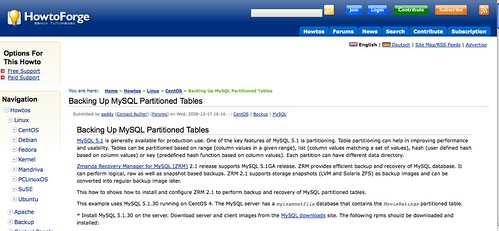
This tutorial presents MySQL 5.1 in a short paragraph, and then starts talking about a commercial backup application, as if it were the only way of backing up partitioned tables.
The title, for sure, is misleading. Backing Up MySQL Partitioned Tables. Reading such a title, readers expect either a list of possible solutions, or being presented with the only existing way of dealing with this task. Instead, the only instructions that you get is how to use the above mentioned tool, which is definitely not the only way of getting the job done. It is also doubly misleading because, since partitioning is a new technology, the casual reader may think "oh? What's peculiar with partitioned tables? do I need to take extra care to back them up?. Instead, there's nothing special about partitioned tables. Depending on the backup method, handling of partitioned tables is completely transparent for the user.
I don't doubt that this tool can do the job, but there are native tools with MySQL that can accomplish the task just as well.
There are several ways of backing up a partitioned table. But the first one that springs to mind is mysqldump.
The backup is as simple as:
mysqldump --opt db_name table_name > file.dump
The restore is equally simple:
mysql db_name < file.dump 

Now, to be fair, I know one case where the backup of partitioned tables is problematic, but the one presented in the FUD tutorial was not it. The only possible trouble happens when you define partitions with different data directories and want to restore the table to a server that has a different directory structure. I had this problem two years ago, and I solved it by splitting the dump to keep the DDL and the DML in separate scripts. I wonder if there is a method that can detect and fix this problem on the spot.

Update: Here's the original article I am talking about.
howto_forge article about partition backup

Wednesday, December 10, 2008

Guest Post: Philip Stoev. If you love it break it. Getting started with the RQG


Philip Stoev

I am glad to host in these pages a post by Philip Stoev, a remarkable QA engineer, creative, resourceful, and a notorious troublemaker.
I met Philip by email in 2007, when I was exploring his Perl modules, which I used for one of my most rewarding articles. A few months later, when we met in person during the MySQL Developers Meeting, Philip was hired as a QA engineers, with my warmest recommendations.
This post is about the Random Query Generator, which is also the topic of a MySQL University session. Thanks, Philip!


Want to test and break MySQL without having to cook up your own test framework?

Sun Microsystems have open-sourced the Random Query Generator, a new tool for generating tables with random data and then executing a random query workload against them. Both the data and the queries are fully configurable.

For example, assume that you want to evaluate how well partitioning will work for your workload:

Step1. Describe your tables.

Create a configuration file named partitioning.zz, instructing the tool to create a partitioned table containing a few varchar() fields. The format of the file is described in the Forge wiki. The configuration file will contain the following.

$tables = {
rows => [65535],
pk => [ 'integer not null auto_increment' ],
partitions => [ 'PARTITION BY KEY (pk) PARTITIONS 2' ],
};

$fields = {
types => [ 'varchar', 'char' ],
indexes => [undef ]
};

$data = {
strings => [ 'english' ]
}
This basically says "create a table with 64K rows, two char fields, 2 partitions, auto_increment primary key and fill it with English words."

Step2. Describe your workload.

The configuration file describing the workload takes the form of an SQL grammar. Its format is described in the Forge wiki. For example, let's check how updates on a primary key are doing. Let's name the configuration partitioning.yy and put the following in:
query:
UPDATE _table SET _field_no_pk = _english WHERE `pk` = _smallint_unsigned;
This says "UPDATE a random non-PK field from the table to a random english word for a random value of the PK".

This is just the very tip of the iceberg. Arbitrarily complex SQL queries can be expressed with the appropriate SQL grammar.

Step3. Run the test!

Fetch the Random Query Generator from Launchpad:
bzr branch lp:~randgen/randgen/main
and then run the test:
perl runall.pl \
--basedir=/path/to/mysql-distribution \
--gendata=partitioning.zz \
--grammar=partitioning.yy \
--queries=100000 \
--threads=10 \
--duraton=360
This will start a server by using the specified MySQL location and will then run random queries in 10 threads, executing up to 100000 queries per thread for no more than 360 seconds.

While the test is running, monitor the performance of your server (which will run on port 19306). Check the CPU usage and use SHOW STATUS and mysqladmin status to see how things are going. To see performance without partitioning, edit the partitioning.zz file and remove the "partitions" line and run the test again.

You are also most welcome to join the MySQL University session on the RQG, to be held tomorrow, December 11 at 14:00 UTC / 8am CST (Central) / 9am EST (Eastern) / 14:00 BST / 15:00 CET / 17:00 MDT (Moscow).

More information is available here:

Tuesday, December 09, 2008

Speaking about the Event Scheduler at the Users Conference 2009


MySQL Users Conference 2009

The approvals are coming. I will be speaking at the MySQL Users Conference 2009.
Using the event scheduler. The friendly behind-the-scenes helper. My co-speaker will be none other than Andrey Hristov, the designer and implementer of the Event scheduler, one of the main features of MySQL 5.1.

Monday, December 01, 2008

The partition helper - Improving usability with MySQL 5.1 partitioning


MySQL Forge
I talked several times about partitioning usability. In my many tests of partitioning I found myself in need of generating list of partitions for a given range.
I made the Partition Helper (see code at the end of this post) to scratch this particular itch, i.e. making partitions reasonably quickly and without thinking too much.
The Partition Helper is a Perl script that converts some simple options into lots of partitions.
The detailed reference manual lists all the options and many examples.
Here, I would like to show just an example.
Say, you want to create partitions in table blog_posts by monthly intervals on column published. Given that you have data for the last two years, you use the partition helper like this:
./partitions_helper --table=blog_posts \
--column=published \
--interval=month \
--start=2007-01-01 \
--end=2009-01-01
ALTER TABLE blog_posts
PARTITION by range (to_date(published))
(
partition p001 VALUES LESS THAN (to_days('2007-01-01'))
, partition p002 VALUES LESS THAN (to_days('2007-02-01'))
, partition p003 VALUES LESS THAN (to_days('2007-03-01'))
, partition p004 VALUES LESS THAN (to_days('2007-04-01'))
, partition p005 VALUES LESS THAN (to_days('2007-05-01'))
, partition p006 VALUES LESS THAN (to_days('2007-06-01'))
, partition p007 VALUES LESS THAN (to_days('2007-07-01'))
, partition p008 VALUES LESS THAN (to_days('2007-08-01'))
, partition p009 VALUES LESS THAN (to_days('2007-09-01'))
, partition p010 VALUES LESS THAN (to_days('2007-10-01'))
, partition p011 VALUES LESS THAN (to_days('2007-11-01'))
, partition p012 VALUES LESS THAN (to_days('2007-12-01'))
, partition p013 VALUES LESS THAN (to_days('2008-01-01'))
, partition p014 VALUES LESS THAN (to_days('2008-02-01'))
, partition p015 VALUES LESS THAN (to_days('2008-03-01'))
, partition p016 VALUES LESS THAN (to_days('2008-04-01'))
, partition p017 VALUES LESS THAN (to_days('2008-05-01'))
, partition p018 VALUES LESS THAN (to_days('2008-06-01'))
, partition p019 VALUES LESS THAN (to_days('2008-07-01'))
, partition p020 VALUES LESS THAN (to_days('2008-08-01'))
, partition p021 VALUES LESS THAN (to_days('2008-09-01'))
, partition p022 VALUES LESS THAN (to_days('2008-10-01'))
, partition p023 VALUES LESS THAN (to_days('2008-11-01'))
, partition p024 VALUES LESS THAN (to_days('2008-12-01'))
, partition p025 VALUES LESS THAN (to_days('2009-01-01'))
);
The above command can be also expressed as
./partitions_helper --table=blog_posts --column=published --interval=month \
--start=2007-01-01 --partitions=25
Or you can shorten it, if you remember the small options:
./partitions_helper -t blog_posts -c published -i month -s 2007-01-01 -p 25
More options are available. You can see them using
./partitions_helper --help
Enjoy!

Update Here's the code to the Partition helper, published here after MySQL Forge was taken down.

#!/usr/bin/perl
#    The MySQL Partitions helper
#    Copyright (C) 2008, 2009 Giuseppe Maxia
#
#    This program is free software; you can redistribute it and/or modify
#    it under the terms of the GNU General Public License as published by
#    the Free Software Foundation; version 2 of the License
#
#    This program is distributed in the hope that it will be useful,
#    but WITHOUT ANY WARRANTY; without even the implied warranty of
#    MERCHANTABILITY or FITNESS FOR A PARTICULAR PURPOSE.  See the
#    GNU General Public License for more details.
#
#    You should have received a copy of the GNU General Public License
#    along with this program; if not, write to the Free Software
#    Foundation, Inc., 51 Franklin St, Fifth Floor, Boston, MA  02110-1301  USA

#
# This program creates a ALTER TABLE statement to add or reorganize 
# date based partitions for MySQL 5.1 or later
#

use strict;
use warnings;
# use diagnostics;
use English qw( ‐no_match_vars ) ;
use Getopt::Long qw(:config no_ignore_case );
use Data::Dumper;

my $VERSION = '1.0.4';

#
# Parse options are fully qualified options with descriptive help,
# parse string for the command line, and sort order for the help
#
my %parse_options = (
    table           =>  {
                            value   => '',
                            parse   => 't|table=s',
                            help    => [
                                        'The table being partitioned',
                                        '(no default)'
                                       ],
                            so      =>  20,
                        },
    column          =>  {
                            value   => '',
                            parse   => 'c|column=s',
                            help    => [
                                        'The partitioning column',
                                        '(no default)',
                                       ],
                            so      =>  30,
                        },
    interval        =>  {
                            value   => 'month',
                            parse   => 'i|interval=s',
                            help    => [
                                        'The interval between partitions',
                                        'Accepted: "year", "month", "week", "day", or a number',
                                        '(default: month) ',
                                       ],
                            so      =>  40,
                        },
    partitions      =>  {
                            value   => 0,
                            parse   => 'p|partitions=i',
                            help    => [
                                        'How many partitions to create',
                                        '(default: 0) ',
                                       ],
                            so      =>  50,
                        },
    first_partition =>  {
                            value   => 1,
                            parse   => 'first_partition=i',
                            help    => [
                                        'the first partition to create',
                                        '(default: 1) ',
                                       ],
                            so      =>  60,
                        },
    reorganize      =>  {
                            value   => '',
                            parse   => 'reorganize=s',
                            help    => [
                                        'the partition(s) to reorganize',
                                        '(default: none) '
                                       ],
                            so      =>  70,
                        },
    
    start           =>  {
                            value   => '2001-01-01',
                            parse   => 's|start=s',
                            help    => [
                                        'the minimum partitioning value',
                                        '(default: 1 for numbers, 2001-01-01 for dates) '
                                       ],
                            so      =>  80,
                        },
    end             =>  {
                            value   => '',
                            parse   => 'e|end=s',
                            help    => [
                                        'The maximum partitioning value',
                                        'Used unless --partitions is used',
                                        '(no default) ',
                                       ],
                            so      =>  90,
                        },
    function             =>  {
                            value   => '',
                            parse   => 'f|function=s',
                            help    => [
                                        'The partitioning function to use in the "range" declaration',
                                        '(default: to_days, unless --list is used) ',
                                       ],
                            so      =>  100,
                        },
    list             =>  {
                            value   => 0,
                            parse   => 'l|list',
                            help    => [
                                        'Use the COLUMNS feature (versions >= 5.5)',
                                        '(default: no) ',
                                       ],
                            so      =>  110,
                        },
     maxvalue       =>  {
                            value   => 0,
                            parse   => 'x|maxvalue',
                            help    => [
                                        'Adds MAXVALUE as last partition',
                                        '(default: disabled) ',
                                       ],
                            so      =>  115,
                        },
    prefix           =>  {
                            value   => 'p',
                            parse   => 'prefix=s',
                            help    => [
                                        'prefix for partition name',
                                        '(default: p) ',
                                       ],
                            so      =>  120,
                        },
    explain          =>  {
                            value   => 0,
                            parse   => 'explain',
                            help    => [
                                        'show the current option values',
                                        '(default: no) ',
                                       ],
                            so      =>  130,
                        },

    version             =>  {
                            value   => 0,
                            parse   => 'version',
                            help    => [
                                        'display the version',
                                        '(default: none) ',
                                       ],
                            so      =>  400,
                        },
    help             =>  {
                            value   => 0,
                            parse   => 'h|help',
                            help    => [
                                        'display the help page',
                                        '(default: no) ',
                                       ],
                            so      =>  500,
                        },
);

# 
# convert parse options to simple options
#
my %options = map { $_ ,  $parse_options{$_}{'value'}}  keys %parse_options;

# 
# get the options from the command line
#
GetOptions (
    map { $parse_options{$_}{parse}, \$options{$_} }        
        grep { $parse_options{$_}{parse}}  keys %parse_options 
) or get_help();

get_help() if $options{help};

if ($options{version}) {
    print credits();
    exit 0;
}


# print Dumper(\%options) ; exit;

my %valid_intervals = (
    day   => 1,
    week  => 1,
    month => 1,
    year  => 1,
);

#
# start and end dates
#
my ($syear, $smonth, $sday) = ();
my ($eyear, $emonth, $eday) = ();

#
# deals with placeholder features
#

for my $op ( qw(operation) ) {
    if ($options{$op}) {
        die "option <$op> is not implemented yet\n";
    }
}

# 
# check that a table and column are given
#
unless ($options{table}) {
    die "table name required\n";
}

unless ($options{column} or $options{reorganize} ) {
    die "column name required\n";
}

#
# accept only one of --end or --partitions
#
if ($options{end} && $options{partitions}) {
    die "too many quantifiers. Use EITHER '--partitions' OR '--end' \n";
}

#
# check that we parsed a valid interval
#
if ( $options{interval} =~ /^\d+$/) {
    unless ($options{start} =~ /^\d+$/) {
        $options{start} = 1;
    }
    if ($options{end}) {
        unless ($options{end} =~ /^\d+$/) {
            die "the end value must be a number\n";
        } 
        if ($options{end} < $options{interval}) {
            die "the end value must be bigger than the interval\n";
        }
        if ($options{end} <= $options{start}) {
            die "the end value must be bigger than the start\n";
        }
        $options{partitions} = int( ($options{end} +1 - $options{start}) / $options{interval});
    }
}
else {
    unless (exists $valid_intervals{ $options{interval} } ) {
        die "invalid interval specified: $options{interval}\n";
    }
    #
    # for year,  month, or week the function must be to_days
    #
    unless ($options{list}) {
        $options{function} = 'to_days' unless $options{function};
    }

    #
    # check the start date
    #
    if ( $options{start} =~ /(\d{4})[\-\.\/](\d+)[\-\.\/](\d+)/) {
        ($syear, $smonth, $sday) = ($1, $2, $3);
        $smonth +=0;
        $sday +=0;
        #print "start $syear $smonth $sday\n";
    }
    else {
        die "invalid date $options{start}\n";
    }
    #
    # check the end date
    #
    if ($options{end}) {
        if ( $options{end} =~ /(\d{4})[\-\.\/](\d+)[\-\.\/](\d+)/) {
            ($eyear, $emonth, $eday) = ($1, $2, $3);
            $emonth +=0;
            $eday +=0;
            # print "end $eyear $emonth $eday\n";
        }
        else {
            die "invalid date $options{end}\n";
        }
        if ($options{interval} eq 'year') {
            $options{partitions} = $eyear - $syear +1;
        }
        elsif ($options{interval} eq 'month') {
            my $months =   (12 - $smonth) 
                 + ( ($eyear - $syear -1) * 12 )
                 + $emonth + 1;
            # print $months,$/;
            $options{partitions} = $months;
        }
        elsif ($options{interval} eq 'week') {
            $options{partitions} = weeks_between($syear, $smonth, $sday,
                                                 $eyear, $emonth, $eday);
        }
        elsif ($options{interval} eq 'day') {
            $options{partitions} = days_between($syear, $smonth, $sday,
                                                 $eyear, $emonth, $eday);
        }
    }       
}

#
# there must be a valid number of partitions
#

unless ($options{partitions} && ($options{partitions} =~ /^\d+$/) ) {
    die "number of partitions required. Use EITHER '--partitions' OR '--end'\n";
}

if ($options{partitions} > 1024) {
    die "too many partitions ($options{partitions}). Maximum allowed is 1024\n";
} 
else {
    print "# partitions: $options{partitions}\n";
}

#
# don't accept a function if COLUMS is being used
#
if ( $options{function} && $options{list} ) {
    die "you must specify either list or function\n";
}

if ($options{explain}) {
    show_options();
}

# print Dumper(\%options) ; exit;

# -----------------------------------------
# start building the ALTER TABLE statement
# -----------------------------------------

print "ALTER TABLE $options{table} \n";
if ($options{reorganize} ) {
    print "REORGANIZE PARTITIONS $options{reorganize} INTO \n";
    $options{prefix} = 'pr';
}
else {
    print "PARTITION by range " ;

    if ($options{function}) {
        print "($options{function}(";
    }
    elsif ($options{list}) {
        print "columns(" 
    }
    else {
        print "("
    }

    print "$options{column}";

    if ($options{function}) {
        print ")";
    }

    print ")\n";
}

print "(\n";

make_partitions( $options{interval});

print ");\n";


# -----------------------------------------
# functions
# -----------------------------------------

sub make_partitions {
    my ($interval) = @_;
    my $partitions_done=0;
    my $p_year  = $syear;
    my $p_month = $smonth;
    my $p_day = $sday;
    my $func_start = 'to_days('; #$options{function};
    my $func_end = ")";
    if ($options{list}) {
        $func_start = "";
        $func_end = "";
    }
    for my $part ($options{first_partition} .. 
            $options{first_partition} + $options{partitions} -1 ) {
        if ($partitions_done) {
            print ", ";
        }
        else {
            print "  "
        }
        $partitions_done++;

        if ($interval =~ /^\d+$/) {
            printf "partition %s%03d VALUES LESS THAN (%d)\n", 
                $options{prefix},
                $partitions_done,
                ($options{start} + (($partitions_done - 1) * $interval)) + $interval;
        }
        else {
            printf "partition %s%03d VALUES LESS THAN (%s'%4d-%02d-%02d'%s)\n", 
                $options{prefix},
                $partitions_done,
                $func_start,
                $p_year,
                $p_month,
                $p_day,
                $func_end;
            if ($interval eq 'day') {
                ($p_year,$p_month,$p_day) = next_day($p_year, $p_month, $p_day);
            }
            elsif ($interval eq 'week') {
                ($p_year,$p_month,$p_day) = next_week($p_year, $p_month, $p_day);
            }
            elsif ($interval eq 'month') {
                ($p_year,$p_month) = next_month($p_year, $p_month);
            }
            elsif ($interval eq 'year') {
                ($p_year,$p_month) = next_year($p_year, $p_month);
            }
            else {
                die "unsupported interval\n";
            }
        }
    }
    if ($options{'maxvalue'}) {
            printf ", partition %s%03d VALUES LESS THAN (MAXVALUE)\n", 
                $options{prefix},
                ++$partitions_done;
    }
}

sub next_year {
    my ($y, $m) = @_;
    $y++;
    return ($y, $m);
}

sub next_week {
    my ($y, $m, $d) = @_;
    for my $i (1 .. 7) {
        ($y, $m, $d) = next_day($y, $m, $d);
    }
    return ($y, $m, $d);
}

sub next_day {
    my ($y, $m, $d) = @_;
    $d++;
    $m += 0;
    my $last_day = days_in_month($y, $m);
    if ($d > $last_day) {
        $d = 1;
        $m++;
    }
    if ($m > 12) {
        $m = 1;
        $y++;
    }
    return ($y, $m, $d);
}

sub is_leap_year {
    my ($y) = @_;
    if (($y % 400) == 0) {
        return 1;
    }
    elsif (($y % 100) == 0) {
        return 0;
    }
    elsif (($y % 4) == 0) {
        return 1
    }
    return 0
}

sub days_in_month {
    my ($y, $m) = @_;
    $m = $m +0;
    my %last_day = (
        1 => 31,
        2 => 28,
        3 => 31,
        4 => 30,
        5 => 31,
        6 => 30,
        7 => 31,
        8 => 31,
        9 => 30,
        10=> 31,
        11=> 30,
        12=> 31,
    );
    if (($m ==2) and (is_leap_year($y))) {
        $last_day{2} = 29;
    }
    return $last_day{$m};
}

sub days_to_year_end {
    my ($y, $m, $d) = @_;
    my $days = days_in_month($y,$m) - $d +1 ;
    for my $month ( $m +1 .. 12 ) {
        $days += days_in_month($y, $month);
    }
    return $days;
}

sub months_between {
    my ($syear, $smonth,
        $eyear, $emonth) = @_;
 
    my $months =   (12 - $smonth) 
         + ( ($eyear - $syear -1) * 12 )
         + $emonth + 1;
    return $months;
}
 
sub days_between {
    my ($syear, $smonth, $sday,
        $eyear, $emonth, $eday) = @_;
    # print "start $syear, $smonth, $sday\n end $eyear, $emonth, $eday\n";
    my $days =0;
    if (  sprintf ("%4d%2d%2d", $eyear, $emonth, $eday) 
          lt 
          sprintf("%4d%2d%2d", $syear, $smonth, $sday) ) 
    {
        die "start interval > end interval\n";
    }
    while (    ($syear < $eyear) 
            or ( ($syear == $eyear) and ($smonth < $emonth) ) 
            or ( ($syear == $eyear) and ($smonth == $emonth) and ($sday < $eday) ) 
        ) {
        if ($syear < $eyear) {
            $days += days_to_year_end($syear, $smonth, $sday);
            $syear++;
            $smonth=1;
            $sday=1;
        }
        elsif ($smonth < $emonth) {
            $days += days_in_month($syear, $smonth) - $sday;
            ($syear, $smonth) = next_month($syear, $smonth);
            $sday =1;
        }
        elsif ($sday < $eday) {
            $days += $eday - $sday +1;
            $sday = $eday;
        }
    }
    return $days;
}

sub weeks_between {
    my ($syear, $smonth, $sday,
        $eyear, $emonth, $eday) = @_;
   my $days = days_between ($syear, $smonth, $sday,
            $eyear, $emonth, $eday);
    # print $days, "\n"; exit;
    return int ($days / 7) +1;
}

sub next_month {
    my ($y, $m) = @_;
    if ($m  == 12) {
        $m = 1;
        $y++;
    }
    else {
        $m++;
    }
    return ($y, $m);
}

sub get_help {
    my ($msg) = @_;
    if ($msg) {
        warn "[***] $msg\n\n";
    }

    my $HELP_MSG = q{};
    for my $op ( 
                sort { $parse_options{$a}{so} <=> $parse_options{$b}{so} } 
                grep { $parse_options{$_}{parse}}  keys %parse_options  ) {
        my $param =  $parse_options{$op}{parse};
        my $param_str = q{    };
        my ($short, $long ) = $param =~ / (?: (\w) \| )? (\S+) /x;
        if ($short) {
            $param_str .= q{-} . $short . q{ };
        } 
        $long =~ s/ = s \@? / = name/x;
        $long =~ s/ = i / = number/x;
        $param_str .= q{--} . $long;
        $param_str .= (q{ } x (40 - length($param_str)) );
        my $text_items = $parse_options{$op}{help};
        for my $titem (@{$text_items}) {
            $HELP_MSG .= $param_str . $titem . "\n";
            $param_str = q{ } x 40;
        }
        if (@{$text_items} > 1) {
            $HELP_MSG .= "\n";
        }
        # $HELP_MSG .= "\n";
   }

   print credits(),
          "syntax: $PROGRAM_NAME [options] \n", 
          $HELP_MSG;
    exit( $msg ? 1 : 0 );
}

sub credits {
    my $CREDITS = 
          qq(    The Partition Helper,  version $VERSION\n) 
        . qq(    This program creates a ALTER TABLE statement to add or reorganize\n )
        . qq(    partitions for MySQL 5.1 or later\n)
        . qq(    (C) 2008-2010 Giuseppe Maxia\n);
    return $CREDITS;
}

sub show_options {
    printf "# %-20s %-20s %s\n", 'options', 'default', 'value';
    printf "# %-20s %-20s %s\n", '-' x 20, '-' x 20, '-' x 20;
    for my $op ( sort { $parse_options{$a}{so} <=> $parse_options{$b}{so} }
            keys %parse_options) {
        my $v = $options{$op};
        my $d = $parse_options{$op}{value};
        printf "# %-20s %-20s %s\n", 
                $op, 
                '(' . (defined $d ? $d : '') . ')',  
                defined $v ? $v : '' ;
    }
    print '# ', '-' x 62, "\n";
}

Friday, November 28, 2008

Yet another replication trap


replication and engines

When I filed Bug#39197 replication breaks with large load with InnoDB, flush logs, and slave stop/start, I genuinely thought that it was a serious problem. I was a bit puzzled, to tell the truth, because the scenario that I was using seemed common enough for this bug to be found already.
Anyway, it was verified independently, but there was a catch. The script in the master was using SET storage_engine=InnoDB to create the tables necessary for the test. That looked good enough to me. The script was indeed creating InnoDB tables on the master. The trouble was that the "SET" command is not replicated. Thus the slaves were using the default storage engine (i.e. MyISAM). That reduces the scenario to a case were I was splitting a transaction and trying to apply it to a non transactional table. Not a bug, as Andrei Elkin and Sveta Smirnova correctly found out, but not an easy error to spot either.
According to the manual, using the storage_engines variable allows for a certain degree of flexibility in replication. The non-replication of this instruction that affects DDL commands is described as a feature. In my experience, it's a bug, by design even, but this is my personal opinion.

Wednesday, November 26, 2008

Using MySQL 5.1 in production for over a year


Adam Donnison

Lenz has just published an interview to Adam Donnison, Senior Web Developer in the MySQL web team. Under his watch, the site at mysql.com has been powered by MySQL 5.1 for one and half years.
In production! Talk about eating your own dog food!
In addition to the database server, Adam has spearheaded the test of Enterprise tools and the Query Analyzer. Excellent example, Adam!

Monday, November 17, 2008

Meeting MySQL community in Paris - November 18, 2008


MySQL Proxy

I will meet the MySQL community in Paris on November 18, 2008 at 19:30.
I will speak about MySQL Proxy Wizardry, and discuss with the community about any subject that will come up.
The place:
1 rue royale, 227 Bureaux de la Colline
92210 Saint-Cloud
Bâtiment D 9ème étage
Tel : 01 78 15 24 00

Sunday, November 16, 2008

OpenSQLCamp - Good Job, Baron!

opensqlcamp - Good job, Baron!
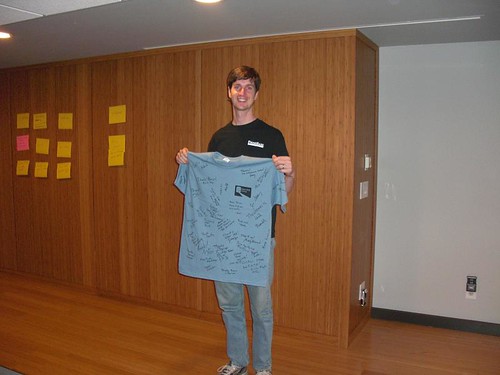
Kudos to Baron Schwartz, who has shown everyone that you can organize a conference from scratch, without the logistics of a company. He has motivated other people in the community and received spontaneous help, which in turn became a web site, sponsor donations, free food for the participants, T-shirt, bags, internet connection, and a glorious feeling of camaraderie throughout the event.
Well done, Baron!

The picture shows a surprised Baron holding a T-shirt covered with "thank you Baron"s, secretly signed by all participants and finally awarded to him in public.

Saturday, November 15, 2008

OpenSQLCamp - Pictures from the first day

The OpenSQLCamp started yesterday in Charlottesville, VA.
As expected, the gathering is impressive. There are many well known names from the open source database world. MySQL is probably overrepresented, but that's fair, considering its wide adoption.

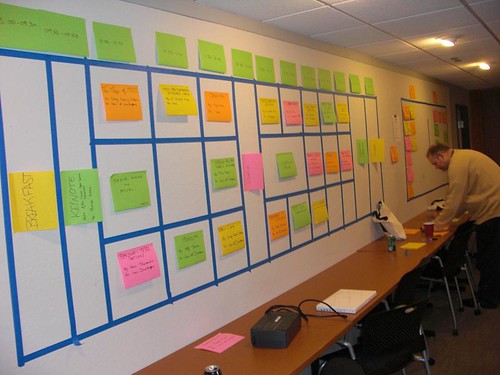
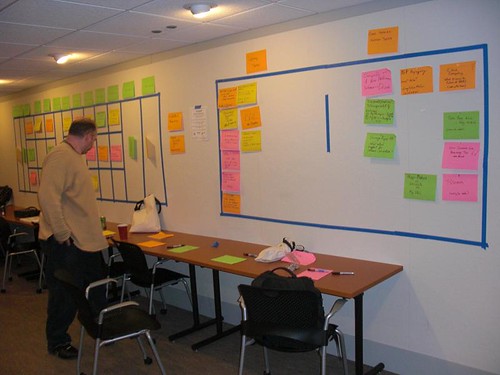
Yesterday was an informal "meet anyone and let's see what we do tomorrow". The schedule, as you can see, is very dynamic.
OpenSQLCamp
OpenSQLCamp - flexible schedule

Friday, November 14, 2008

At the Open SQL Camp


Just arrived to Charlottesville, VA, with Dups.
We drove from Baltimore, MD, where we had an enjoyable MySQL meetup yesterday. The room was small, but packed to capacity with open source enthusiasts.
Now waiting for the "opening ceremony" at 6pm, when we will fine tune tomorrow's schedule. The list of attendees is impressive. More than 100 people are registered. It seems to be a very interesting gathering.

OpenSQL Camp 2008

Wednesday, November 12, 2008

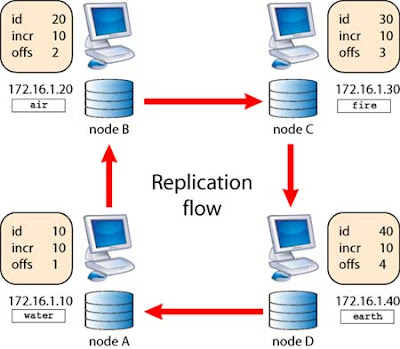
circular replication - Will you use it?


MySQL Circular replication
Three unrelated facts reminded me of a popular article about MySQL replication that I wrote long time ago.
  • A reader of that article told me that he used information I wrote to set up a circular replication in production, and it is still working!
  • A new page on circular replication in MySQL manual was just published.
  • During yesterday's meetup in New York, an attendee asked advice about broken replication in a circular scheme, and I suggested reading all the caveats that I listed in my article.

I recall reading in High Performance MySQL 2nd edition that circular replication is not recommended, and I agree on the reasons. I wrote that article as it was the result of my research, but I don't recommend circular replication either.
All of the above lead to the questions:
  • Who is using circular replication in production?
  • Who prefers circular replication to more robust methods, and why?

Baltimore MySQL meetup - November 13


The Baltimore MySQL Meetup is scheduled for November 13th at 6pm
The place:
Lotame Solutions, Inc.
6085 Marshalee Drive
Suite 210 Elkridge, MD 21075

We'll talk about MySQL Proxy, and anything else that looks suitable, depending on the crowd's requests.
Thanks to Greg Haase for organizing.

Tuesday, November 11, 2008

New ideas about MySQL Sandbox at the Boston meetup


MySQL Sandbox

Presenting a topic to a new audience is a two ways learning experience. The attendees learn what the presenter came prepared to say, and in presence of an attentive audience, the presenter can learn something on the spot.
During today's Boston MySQL meetup, I got two interesting ideas aboou how to improve MySQL Sandbox.

  • Using the Sandbox as a test for the future production environment is useful. But it would be even more useful if there were a simple way of transferring the contents of a well tested Sandbox to the main server, or transferring the setup of a successfully tuned replication scheme to several production servers. Currently, this can't be done easily, but I have a few ideas worth checking.

  • The Sandbox can provide one or more servers for development and tests. Every server can be created by a knowledgeable administrator. It would be useful to have a sandbox provider that can create a sandbox on the spot, with an automatic check about the port being available. So the tester can simply ask for another server of a given version, and the Sandbox will be created with a non-conflicting port. There are several ways of implementing this idea. Perhaps the easiest one, suggested by an attendee, is to register the used ports.

Both these ideas are worth exploring. If you happen to care about them and have a good idea on their implementation, please contact me, or simply comment to this post. Thanks to all the ones who have brainstormed about these issues!

Monday, November 10, 2008

New York MySQL meetup - November 11


The New York MySQL Meetup is scheduled for November 11th at 6pm
The place: Suspenders Restaurant
111 Broadway
at Thames St New York, NY 10006
212-732-5005

We'll talk about MySQL Proxy, and anything else that looks suitable, depending on the crowd's requests.
Thanks to Philip Antoniades for the organization.

Sunday, November 09, 2008

Boston MySQL meetup - November 10


The Boston MySQL meetup is held on November 10th at 7pm. The place is
MIT Building E51
4 Amherst St
Room 372 Cambridge, MA 02142
857 205 9786

We'll talk about MySQL Sandbox, and about any relevant MySQL topic.

On the road with Dups


Now that Dups is the Community Relations Manager for North America, we'll start working together in the most active way. Next week, we'll be busy at meetups in New York and Baltimore, and then it will be full immersion in Charlottesville for the Open SQL Camp.
OpenSQL Camp 2008

Saturday, November 08, 2008

Italians strike back


What follows is the text of my "Swedish" blog.
Look mom, I am blogging in Swedish!
I am starting a blog in Swedish. Now, why should I do such a thing? I usually blog in English, and I don't even bother blogging in my native Italian. Most importantly, I do not speak Swedish at all. So, why bother?
My friend and colleague Kaj Arnö had the gall of starting a blog in Italian, a fact that surprised me and made me envious at the same time.

He started talking about Italy, a country he visits often and he loves. I have little experience of Finland, having visited only once, but where I enjoyed warm hospitality.
I Visited Kaj in his homeland, in Nagu, a charming island West of Turku. The weather was not warm, but friendship and good food was a suitable compensation.

I am choosing to blog in in Swedish because Kaj's mother tongue is Swedish, although he lives in Finland. During my visit to Nagu and other island of the Finnish archipelago, I heard little Finnish and plenty of Swedish.

This experiment wants to show that anyone can blog in (mostly) any language, given the right tools. Hello Kaj!

Monday, November 03, 2008

A quick usability hack with partitioning

A few days ago I was describing a common grievance when using partitions.
When you care at a table, like the following
CREATE TABLE t1 ( d DATE ) 
PARTITION by range (to_days(d))
(
partition p001 VALUES LESS THAN (to_days('2001-01-01'))
, partition p002 VALUES LESS THAN (to_days('2001-02-01'))
, partition p003 VALUES LESS THAN (to_days('2001-03-01'))
);

Then you have the problem of finding out the original values. SHOW CREATE TABLE doesn't help.
show create table t1\G
*************************** 1. row ***************************
Table: t1
Create Table: CREATE TABLE `t1` (
`d` date DEFAULT NULL
) ENGINE=MyISAM DEFAULT CHARSET=latin1 /*!50100 PARTITION BY RANGE (to_days(d)) (PARTITION p001 VALUES LESS THAN (730851) ENGINE = MyISAM, PARTITION p002 VALUES LESS THAN (730882) ENGINE = MyISAM, PARTITION p003 VALUES LESS THAN (730910) ENGINE = MyISAM) */

I spent some time writing a MySQL Proxy module that, among other things, gives you the original values with SHOW CREATE TABLE. However, I was mostly reinventing the wheel in this case, because there is some useful data in the information_schema. Look:

select
PARTITION_NAME,
PARTITION_DESCRIPTION
from
information_schema.PARTITIONS
where
table_schema ='test' and table_name='t1';
+----------------+-----------------------+
| PARTITION_NAME | PARTITION_DESCRIPTION |
+----------------+-----------------------+
| p001 | 730851 |
| p002 | 730882 |
| p003 | 730910 |
+----------------+-----------------------+

This is as informational as the output of SHOW CREATE TABLE, but having the data in a table, allows us to do the trick.

select
PARTITION_NAME ,
from_days(PARTITION_DESCRIPTION) AS original_value
from
information_schema.PARTITIONS
where
table_schema ='test' and table_name='t1';
+----------------+----------------+
| PARTITION_NAME | original_value |
+----------------+----------------+
| p001 | 2001-01-01 |
| p002 | 2001-02-01 |
| p003 | 2001-03-01 |
+----------------+----------------+

More on this subject when I finish working on my Proxy partition helper.

Friday, October 31, 2008

Scary reading advice

Singapore, Feb 2008
Inspired by the Arctic Dolphin's scary movies, I dug out some reading advice that I made during the MySQL Developers meeting in Riga.

Jack Kerouac, On The RoadMap, a fictionalized autobiography of a senior engineer on a cross country bohemian odyssey after failing to deliver 5.1 GA for the fifth time.

Ken Kesey, One flew over the cuckoo's nested query. A story of love and madness involving a quiet Engineering department. When Jeffrey McMurphy, a convicted felon who's faking insanity to escape a prison sentence, is sent to the Database Group asylum, life changes instantly for the other guests.
A subtle tragedy involving a marketing planner, a virgin junior engineer, and a swordfish develops inexorably, leaving the main character with a headache, while the chief of engineering runs away with the bath sink.

Umberto Eco, The name of the release. Young novice Zack of Melk tells the story of his master, Friar Marten of Baskerville, faced with the sudden suicide of his beloved Five-One-Twenty-Two release. The mystery thickens when another release, Five-One-Twenty-Three, is found dead in a puddle of blood, and again when the scribe Five-One-Twenty-Four is poisoned. Three more releases are slaughtered before some light is finally shed on the story, and the murder is revealed, and the surviving release Five-One-Thirty is finally sent to preach in the outside world.